AI Response Evaluation

Evaluate the accuracy, relevance, and consistency of AI responses, and track the impact of model, prompt, or system changes on results as a basis for launch and improvement.

AI Evaluation & Quality Challenges

How do you know whether
AI responses are reliable enough?

When different answers appear to the same question, or the results change after the model is updated,
Response quality will become difficult to predict and verify.

Difficult to quantifyResponse quality and accuracy
Difficult to traceImpact of model changes

AI quality assessment and governance capabilities

From test sets and ground truth to scoring rules and human review, establish a repeatable AI response quality assessment process.

LogsRuntime
Response Logging

Gather necessary inference data

Collect the necessary inputs, outputs and context of the AI system according to the data policy to provide a data basis for evaluation.

  • Track necessary prompts and response content
  • Supports Chatbot and Agent workflows
  • Analysis based on real or test data
Pipeline
Evaluation Pipeline

Repeatable assessment process

Establish a standardized process to evaluate, compare and track large numbers of AI responses in batches.

  • Support batch evaluation and scheduled execution
  • Customizable scoring logic and rules
  • Suitable for different application scenarios and models
Evaluation
Ground Truth

Ground Truth and Test Set Management

Establish standard answers and test materials to provide a consistent comparison benchmark for assessment results.

  • Test set and version management
  • Support manual annotation and correction
  • Establish repeatable and verifiable assessment benchmarks
Scoring
Scoring

Multi-dimensional scoring mechanism

Quantitatively score AI responses based on different indicators to assist in analyzing model and prompt performance.

  • Accuracy and semantic relevance assessment
  • Hallucination and Deviation Detection
  • Produce comparable scoring results
Dashboard
Dashboard

Quality monitoring and analysis dashboard

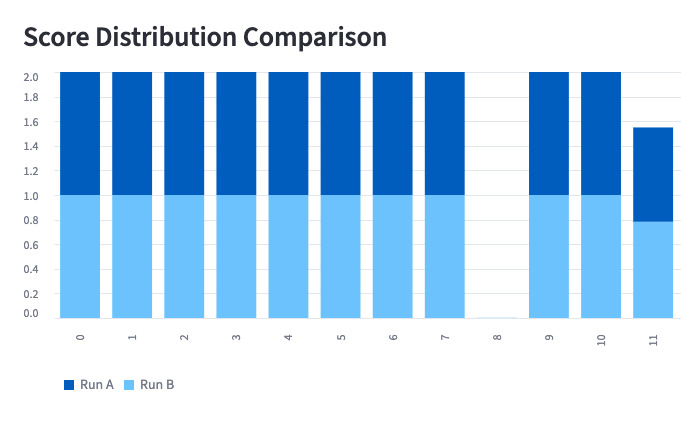
Through visual data, track model performance, version changes and abnormal cases.

  • Visualization of scores and trend changes
  • Model version comparison before and after
  • Exception case analysis and tracking
Deployment
Deployment

Private deployment and data security

Deployment and data processing methods can be selected according to enterprise requirements, and the access and storage of assessment data can be controlled.

  • Supports private cloud and on-premises deployment options
  • Configurable evaluation data processing methods
  • Meet enterprise information security and audit needs
AI Response Evaluation Chart
Quality Governance

Convert AI response quality into quantifiable metrics

Through the standard answer (Ground Truth) and batch evaluation mechanism, AI responses are transformed into comparable and traceable data to help the team continuously optimize model performance.

  • Establish an evaluation baseline: Define standard answers and test cases to support consistent comparison methods
  • Compare responses automatically: Compare AI responses to baseline answers to identify errors and deviations
  • Score across dimensions: Conduct batch assessments for accuracy, relevance and compliance
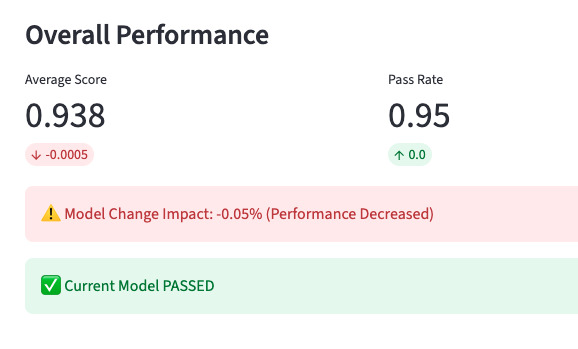
AI Performance Dashboard and Deployment Control
Decision & Control

Use evaluation results to inform release decisions

Set reference thresholds through evaluation results to help the team determine whether models, prompts, or system changes need to be adjusted, reviewed, or postponed.

  • Set release criteria: Assist in judging deployment, adjustment or suspension based on scoring results
  • Track the impact of changes: Compare performance before and after model updates to identify changes in response quality
  • human review mechanism: Add human review to critical workflows and assess quality in important use cases.

Use cases

Support the development, testing and deployment of AI systems, and assist the team in establishing a basis for release decisions and improvement

Conversational AI

Customer service response quality assessment

Analyze whether Chatbot responses are accurate, relevant, and consistent, and help determine whether they meet enterprise service standards.

  • Assess response accuracy and semantic consistency
  • Identify errors and exception responses
  • Establish quantifiable service quality indicators
AI Agent & Workflows

Agent and process execution assessment

Analyze every step in a multi-step AI process to identify errors and performance issues.

  • Evaluate multi-step inference results
  • Locate error nodes in the process
  • Analyze automation task execution quality
Model Iteration

Model version comparison and verification

Compare the output results of different models or settings as a basis for judging whether it is suitable to go online.

  • Comparison of output results between old and new models
  • Analyze differences in response quality
  • Evaluate the impact of model updates
CI/CD for AI

Prompt and system change verification

After prompt or system logic changes, verify the impact on the output results.

  • Comparison of results before and after changes
  • Analyze the impact of Prompt adjustments
  • Pre-deployment quality checks

Import process

From data collection, test sets to scoring and review, establish a repeatable AI quality assessment process

01

Collect AI inference data

Record the necessary inputs, outputs and context of the AI system according to the data policy as the basic data for evaluation.

02

Compare standard answers

Compare responses to Ground Truth or test sets to analyze differences and deviations.

03

Conduct multi-dimensional assessments

Score based on accuracy, relevance, consistency and other indicators to quantify the quality of AI responses.

04

Analyze results and optimize

View results through the dashboard, supporting model adjustment, prompt optimization, human review and deployment judgment.

FAQ

Learn how AI assessment can help teams establish a basis for quality comparison, human review, and release decisions

Where does the assessment data come from? Does it reflect the real situation?
The evaluation can be based on inference data (Logs) from the actual operation of the AI system, or it can use test sets or manually labeled data. The actual adoption method will be configured according to scenarios, risks and data policies.
Will data be leaked during the evaluation process?
Not necessarily. You can choose local, private cloud or other controlled deployment methods according to enterprise requirements, and set rules for access, storage and transmission of assessment data.
How to quantify the quality of AI responses?
Through a multi-dimensional scoring mechanism, the response quality is transformed into comparable data by analyzing indicators such as accuracy, semantic relevance, and compliance.
How to establish Ground Truth (standard answer)?
Existing knowledge bases and test cases can be imported or marked by the team, and continuously updated through version management to keep the evaluation benchmark consistent and trackable.
Does it support batch evaluation of large amounts of data?
Supports batch analysis and scheduled evaluation, and can be used for model backtesting, prompt change comparison and daily quality monitoring. It is still recommended to add human review for high-risk results.
How do assessment results help decision-making?
View scores, trends and exception cases through the dashboard, and compare the performance of different versions as a reference for deployment, adjustment or human review.
Can assessment results replace human review?
Complete replacement is not recommended. Assessment results are suitable as a basis for screening, comparison and tracking; human review should still be retained in high-risk, compliance, financial, medical or customer commitment scenarios.

Start with a set of AI assessment cases

First establish a test set, scoring rules and human review process, and then gradually form a repeatable AI quality assessment system.